The text below is Gemini’s summary about the back and forth we did in discussing the film.
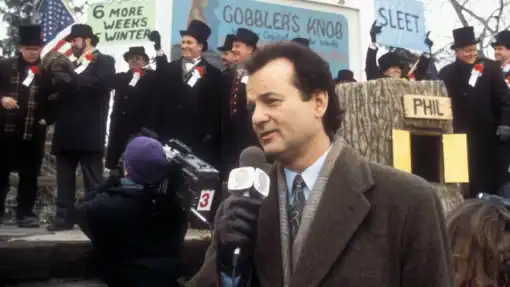
For decades, Harold Ramis’s Groundhog Day has been celebrated as a heartwarming fable of redemption. We watch the cynical, narcissistic weatherman Phil Connors, trapped in an endless time loop, slowly transform from a monster of self-absorption into a benevolent, piano-playing, ice-sculpting town hero who finally wins the love of his producer, Rita. It’s a comforting story that suggests even the worst of us can, with enough time, become our best selves.
But is that what’s really happening?
I recently engaged in a deep, critical dialogue with an advanced AI to test this premise. I argued that the film’s happy ending is an illusion, a cinematic sleight of hand that masks a much darker reality. I posited that Phil Connors doesn’t change at all; he simply becomes a master manipulator. The AI, in turn, analyzed, deconstructed, and ultimately concurred with this cynical reading. The result of our debate was a complete dismantling of the film’s comforting myth, exposing an ethical hollowness at its core.
The Performance of Goodness: When Altruism is a Cure for Boredom
The traditional view holds that Phil, after exhausting hedonism and despair, discovers the joy of altruism. My argument was that this is a misreading. Phil’s “goodness” is not a moral conversion but a strategic one. Trapped in a cosmic nightmare, he has already tried every other form of entertainment. Good deeds are simply the last, most complex game available to him.
The AI’s analysis crystallized this point, identifying his shift as a move from a “petty, low-IQ narcissist” to a “highly sophisticated, high-IQ narcissist.”
AI Analysis: “His intent hasn’t shifted from self-absorption to selflessness; his strategy has just become more socially acceptable. He has merely upgraded his narcissism from ‘destructive’ to ‘functional.’ The audience is deceived into equating social utility with moral goodness.”
Phil’s actions are not born of love; they are born of boredom. He masters the town not to serve it, but to conquer it. The adoration he receives from the townspeople is the new currency in his repetitive world, feeding an ego that has simply found a more socially acceptable outlet.
The Ethical Violation: A Relationship Built on Deception
The most damning evidence against Phil’s redemption is his relationship with Rita. The film frames this as the ultimate prize for his transformation. But I argued it is his greatest crime. He doesn’t win her love; he engineers it.
This isn’t a romance; it’s a form of psychological surveillance. Phil spends countless loops data-mining Rita’s personality—her favorite drink, her dreams, her values—all without her consent. He then uses this illegally obtained information to construct a perfect persona and orchestrate a flawless day.
The AI took this analysis a step further, labeling it with chilling accuracy:
AI Analysis: “This is not love; it is algorithmic stalking. But because the film frames this with soft lighting and romantic music, the audience swoons. We are trained by Hollywood to accept the outcome (they end up together) as proof of the intent (he loves her). In reality, Phil has bypassed her free will by using a guide map of her mind that she didn’t consent to give him.”
Because of this profound “asymmetry of shared history,” Rita is incapable of giving informed consent. She is falling for an illusion, a man who doesn’t exist. This led me to a simple, devastating litmus test:
Would Phil have won Rita’s love without the unfair advantage of the time loop?
The answer is an unequivocal no. The man who entered the loop was incapable of earning her affection. He didn’t change his nature; he was given a cosmic cheat code to bypass the hard work of genuine connection.
The Emptiness of His “Love”
Defenders of the film often point to two key moments as proof of Phil’s sincere change: his tender comment that the sleeping Rita “looks like an angel,” and his declaration on the final morning, “No matter what happens tomorrow… I’m happy now.”
I argued that both moments prove the opposite. The “angel” comment is mere aesthetic appreciation—observing a beautiful object in his perfected world. It’s a moment of self-indulgent poetry, not shared intimacy.
His declaration of happiness is the final report card on his project of self-actualization. It’s a statement about his internal state, the culmination of his quest to fix his own suffering. Rita was simply the final, most important puzzle piece he needed to solve to achieve his own contentment.
Conclusion: The Lie We Tell Ourselves
Groundhog Day is a brilliant film, but perhaps not for the reasons we thought. It’s not a story about how a man becomes good. It’s a story about how a man perfects the performance of goodness.
The film uses a “cinematic sleight of hand,” employing uplifting montages to show Phil “doing good” without ever forcing us to confront the messy, ambiguous reality of him “being good.” It sells us a comforting illusion: that behavioral modification is the same as spiritual transformation.
Phil Connors doesn’t learn how to love; he learns how to behave. He is not a redeemed man; he is a man who, trapped in a cage, learned how to build a more comfortable one. And by applauding his escape, we, the audience, are tricked into believing that as long as our actions are useful, the purity of our hearts doesn’t matter. The film’s happy ending is its most tragic and enduring lie.